How Carpet Clean Drives Recycling and Sustainability
 Carpet Clean is committed to reducing waste and rethinking how carpets, underlay and upholstery are handled after cleaning and replacement. Our sustainability vision sets a clear recycling percentage target: we aim to divert 75% of recoverable materials from landfill by 2028 through reuse, repurposing and material recovery. This carpet cleaning initiative draws on local borough approaches to waste separation — including separated food waste, dry mixed recycling and textile collections — and adapts those best practices to carpet and soft-floor coverings.
We recognise that practical local delivery matters, so our operations integrate with municipal systems: we coordinate with kerbside schedules and borough recycling programmes to make sure materials are prepared in the right streams. Carpet clean crews are trained on what to separate on-site: backing, foam underlay, jute, yarn and metal fixings are sorted where possible, and contaminated material is managed through authorised transfer channels to ensure compliant processing.
 Local transfer stations and household waste recycling centres are the backbone of our logistics. We work with regional transfer sites and civic amenity centres to move materials efficiently, ensuring carpets and components reach specialized processors for textile recycling, foam reclamation or energy recovery when reuse is not viable. Our partnerships prioritise reuse first, recycling second, and only then energy recovery.
Partnerships with Charities and Social Enterprises
CarpetClean actively collaborates with charities to extend the life of carpets, rugs and padding. Where items are suitable, we route gently used rugs and offcuts to local charities, community spaces and furniture reuse organisations that support homelessness projects and community housing. These partnerships include textile banks, local charity shops and social enterprises that specialise in refurbishing floor coverings for community benefit.
Our carpet cleaning services also support carpet reuse schemes: donation-ready rugs are cleaned and delivered to partners instead of being shredded. We prioritise diversion to charities such as local reuse networks and national organisations that accept soft-furnishing donations. This not only reduces waste but supports social value by creating affordable options for local families and community projects.
 Materials we route to charities and reuse programmes:
- Good-condition rugs and area carpets suitable for reuse
- Clean underlay and insulation pads that can be repurposed
- Offcuts and remnant textiles used by community workshops
- Metal fixings and accessories recycled through local scrap schemes
Low-Carbon Fleet, Efficient Routes and Circular Practices
 To reduce transport emissions our fleet transition is well underway: we deploy low-carbon vans including full-electric and plug-in hybrid vehicles for urban routes and smaller diesel-electric models for longer distances when necessary. Route optimisation software, combined with telematics and driver training, reduces fuel use and idling, delivering fewer miles per job and lower CO2 across our carpet cleaners and carpet clean teams.
We measure progress against environmental KPIs: fuel consumption, miles per job and percentage of material recycled or reused. Targets are published internally and inform investment decisions such as additional electric vehicle charging points at depots and shift patterns designed to match borough recycling opening hours and transfer station windows.
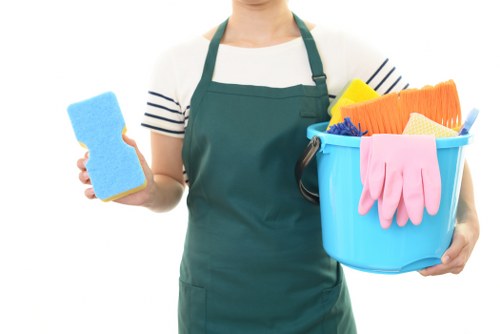
![A male professional cleaner in a light blue apron and yellow rubber gloves stands in a well-lit room, smiling while holding a purple plastic bucket filled with various cleaning sprays and bottles in one hand. In his other hand, he raises a yellow sponge towards the camera, suggesting readiness to clean. The background appears to be a plain, light-coloured wall, indicating a clean, organized indoor environment consistent with typical residential or commercial spaces in London. The cleaner's attire and equipment emphasize a professional approach to cleaning services offered by Carpet Clean, aligned with sustainable practices discussed on the 'Recycling and Sustainability' page connected to the postcode area. The scene captures a moment of active preparation for thorough cleaning tasks, underscoring the company's commitment to quality service in the London region, including surrounding areas like [POSTCODE] and [TOWN]. The focus on equipment and tools highlights attention to detail, cleanliness, and eco-conscious cleaning methods supported by the company.](/pub/_photos/cleaning/f1296125560.jpg) Our broader circular strategy includes product stewardship with suppliers: backing and foam suppliers are encouraged to use recycled content; we prioritise carpets with fewer composite materials to make recycling easier. Where local boroughs operate advanced textile sorting and separate collections, we feed sorted textile streams into those systems to support higher-value recycling instead of landfill.
Our broader circular strategy includes product stewardship with suppliers: backing and foam suppliers are encouraged to use recycled content; we prioritise carpets with fewer composite materials to make recycling easier. Where local boroughs operate advanced textile sorting and separate collections, we feed sorted textile streams into those systems to support higher-value recycling instead of landfill.
Community engagement is central to our approach. We run awareness sessions for property managers and tenants on how to prepare carpets for collection and separation — simple steps such as removing large debris, bagging contaminant-prone waste and labelling donation-ready items dramatically increase reuse rates. These practical tips align with many boroughs' waste separation rules and help ensure recovered materials are accepted by downstream processors.
Reporting and transparency: we publish annual sustainability summaries that detail recycling percentages, diversion volumes and fleet emissions reductions. Our aim is to exceed our 75% recycling target where possible and to continually raise the quality of material recovery, moving away from downcycling towards higher-value recycling and reuse.
By combining targeted recycling percentage goals, collaboration with local transfer stations and charities, and investment in low-carbon vans and circular procurement, Carpet Clean delivers a practical, scalable model for sustainable carpet care. Whether you search for Carpet Clean services, carpet cleaning specialists or carpet cleaners near you, our environmental commitments ensure each job supports a healthier local ecosystem and strengthens borough-level recycling efforts.